
Table of Contents
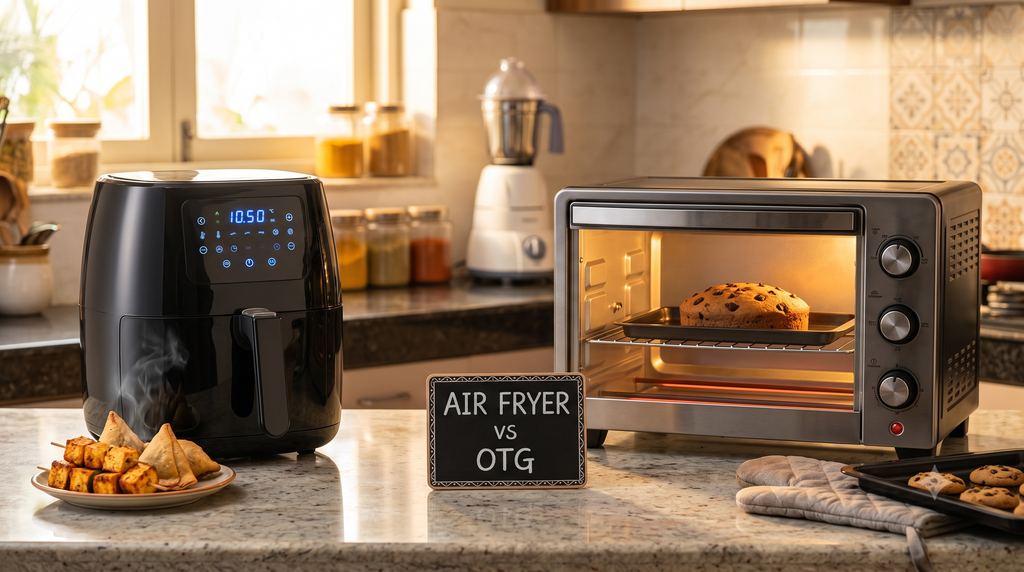
When deciding between an air fryer vs OTG for an Indian kitchen, the confusion is completely valid. Both sit on your countertop, both roast and bake, and both promise healthier cooking with less oil—yet they operate on entirely different heating mechanisms, cook at different speeds, and suit very different daily habits.
What is the full form of OTG? OTG stands for Oven Toaster Grill—a compact countertop electric oven with top and bottom heating elements used for baking cakes, roasting, and grilling. Unlike an air fryer, which uses rapid circulating hot air for crispy fried textures, an OTG relies on gentle radiant heat and a much larger cooking chamber.
Here is a practical, real-world breakdown of the 7 key differences between an air fryer and an OTG to help you pick the right one for your kitchen size, family members, and cooking style.
Quick Decision Guide
- Buy an Air Fryer if: Your priority is quick daily cooking (10–20 minutes), crisping up Indian snacks (paneer tikka, samosas, chicken fry, cutlets), reheating leftovers in under 4 minutes, and cooking for 2–4 people with minimal oil and fast cleanup.
- Looking for top-rated models? Check out our tested guide to [The 7 Best Air Fryers in India (Tested for Daily Cooking)].
- Buy an OTG if: Your primary passion is traditional baking (cakes, sourdough, cookies, breads), batch-roasting large quantities for 5+ family members, or making 10–12 inch pizzas at home.
- Shopping for a baking oven? Compare our picks in [5 Best OTG in India for Tandoor & Baking].
Side-by-Side Comparison: Air Fryer vs OTG
| Feature | Air Fryer | OTG (Oven Toaster Griller) |
| Cooking Mechanism | Intense top heating coil + high-speed convection fan | Top and bottom heating rods (radiant heat) + optional convection fan |
| Preheat Time | 2 – 3 minutes (or zero for many snacks) | 10 – 15 minutes required for baking and roasting |
| Cooking Speed | Very fast (30–40% quicker for small portions) | Slower, steady baking and roasting |
| Texture Delivered | Deep-fried crunch with 80–90% less oil | Soft-baked, evenly risen, toasted, or roasted |
| Typical Capacity | 3.5L – 6.5L basket (Ideal for 2–4 people) | 20L – 45L+ chamber (Great for large family batches) |
| Wet Batter Handling | Limited by perforated basket (runny batter drips) | Ideal for cake tins, muffin trays, and baking dishes |
| Power Consumption | 1400W – 1800W (shorter run time) | 1200W – 2000W (longer run time including preheat) |
| Ease of Cleaning | Quick wash non-stick basket or silicone liner | Multiple crumb trays, wire racks, and larger interior |
1. Heating Mechanism: Rapid Convection vs. Radiant Heat
An air fryer uses a top heating element paired with a high-speed fan to circulate superheated air rapidly around food inside a compact chamber. This intense airflow strips surface moisture quickly, giving snacks a crispy, fried-like outer crust.
- The Catch: Loose, runny batters (like cake batter or pakora batter) cannot be poured directly into a slotted air fryer basket without a solid cake tin or silicone liner.
An OTG uses exposed top and bottom electric heating rods to warm a larger enclosed cavity. Depending on the dial setting, you can run top heat (for grilling/browning), bottom heat (for baking), or both together alongside a convection fan.
- The Catch: Because the chamber is much larger, an OTG needs 10–15 minutes to preheat before food goes in.
2. Tikkas & Kebabs (Paneer, Chicken, Soya Chaap)
- Winner: Air Fryer for quick weekday batches; OTG for party-sized skewers. Concentrated airflow in an air fryer seals moisture inside paneer cubes and chicken tikka while giving a tandoori-style char in 12–15 minutes. An OTG with a motorized rotisserie handles larger batches of skewers evenly, though it takes 25–35 minutes including preheating.
3. Traditional Indian Snacks (Samosas, Cutlets, Mathris)
- Winner: Air Fryer. Pre-cooked, frozen, or lightly brushed samosas, aloo tikkis, and cutlets turn golden and crisp in an air fryer in 10–15 minutes without deep frying. In an OTG, the same snacks take nearly twice as long and can dry out if overbaked.
4. Baking Cakes, Cookies, and Breads
- Winner: OTG. OTGs rely on gentle, even bottom-up radiant heat, allowing cakes, brownies, and breads to rise properly without burning the top crust. Because an air fryer’s heating coil sits inches above the food, cake tops often brown too fast before the center finishes baking.
5. Batch Capacity & Family Size
- Winner: OTG for families of 5+; Air Fryer for 2–4 people. A standard 4.1L–5L air fryer fits about 4–5 medium samosas or 250g–300g of paneer tikka in a single layer (crowding the basket blocks airflow). A 28L–35L OTG lets you bake multiple trays of cookies, a full 9-inch cake, or a large family pizza at once.
6. Reheating Leftovers
- Winner: Air Fryer. An air fryer restores yesterday’s samosas, kachoris, parathas, or leftover pizza slices back to oven-fresh crispness in under 4 minutes—without turning them rubbery like a microwave or waiting 15 minutes for an OTG to heat up.
7. Power Consumption & Daily Convenience
When comparing electricity costs, rated wattage alone does not tell the whole story. While an air fryer draws higher peak wattage (typically 1400W–1800W), its rapid cook cycle means it runs for far less time. An OTG often runs at a slightly lower wattage (1200W–1800W) but stays on longer due to preheating and slower baking times. (For general appliance energy standards in India, you can also check guidelines from the Bureau of Energy Efficiency).
Want exact monthly rupee calculations? Read our breakdown on Air Fryer Electricity Consumption: Real Monthly Cost in India.
Top Recommendations for Indian Homes
If You Choose an Air Fryer:
- Philips HD9252/90 Digital Air Fryer (4.1L): Reliable Rapid Air technology with 7 presets and a 2-year warranty—ideal for 2–4 people. (Link directly to your Philips HD9252/90 review!)
- Cosori 4.7L Air Fryer (CAF-L501): Higher temperature range (up to 230°C) with a square non-stick basket that maximizes cooking surface area. (Link directly to your Cosori review!)
If You Choose an OTG:
- Morphy Richards 30L / 40L OTG: Spacious chamber with motorized rotisserie and convection for serious home bakers.
- Agaro Galaxy / Regency Digital (4.5L to 12L): Great value mid-sized OTG for daily grilling, toasting, and weekend cake baking.
The Verdict
- Choose an Air Fryer if you want fast weekday snacks, crispy tikkas, 4-minute reheating, minimal oil, and effortless basket cleanup.
- Choose an OTG if your heart is set on baking cakes, cookies, and pizzas, or roasting large batches for a big family.
What is the full form of OTG, and how is it different from an air fryer?
OTG stands for Oven Toaster Grill. An OTG uses top and bottom heating rods in a large cavity for slow, even baking and grilling, whereas an air fryer uses a high-speed fan and top coil in a compact basket to crisp food quickly with circulating hot air.
Can an air fryer replace an OTG completely?
Not for every kitchen. An air fryer handles everyday snacks, roasting, and small single-tin bakes easily, but it cannot replace an OTG if you regularly bake full-sized cakes, multiple cookie trays, or large pizzas.
Can I use steel or aluminium utensils in an air fryer?
Yes, heat-resistant stainless steel bowls, aluminium cake tins, and food-grade silicone liners can be used safely inside an air fryer as long as they fit without touching the top heating element or blocking air circulation.
Pingback: 7 Worst Air Fryer Mistakes Everyone Makes (And How to Clean It)
Pingback: Air Fryer Electricity Consumption: Real Monthly Cost in India (Shocking Truth)