
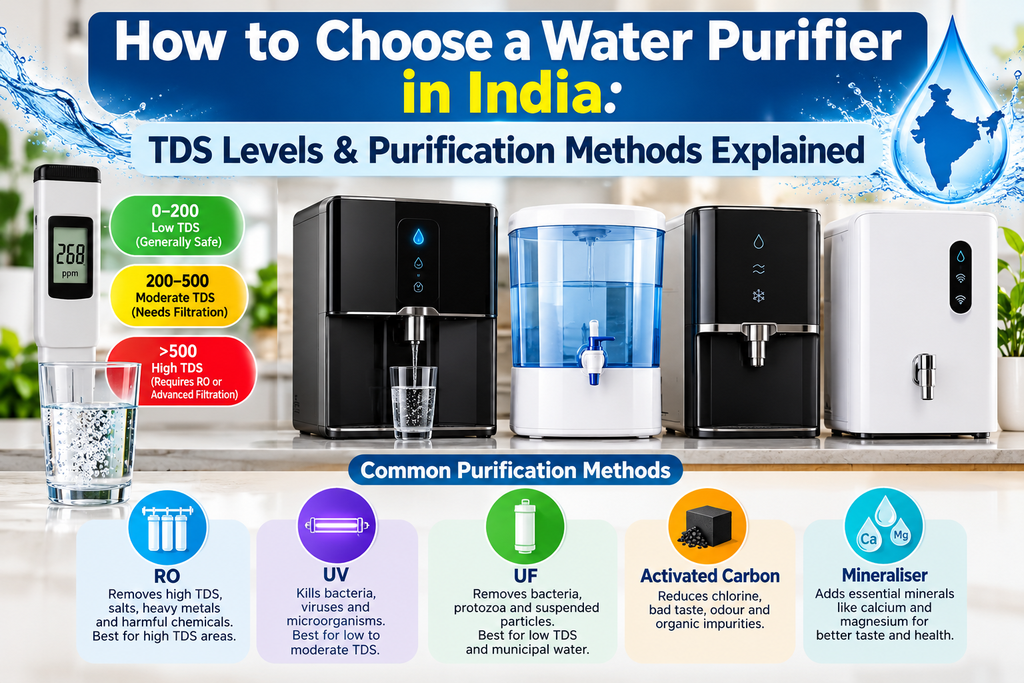
Knowing how to choose a water purifier properly for an Indian kitchen can feel overwhelming
Choosing the right water purifier for an Indian kitchen can feel overwhelming. With municipal water supplies, apartment complex tanker deliveries, and deep borewells all varying wildly in quality, walking into an electronics store or browsing online without a clear plan often leads to buying either an under-powered filter or an overly aggressive machine that strips your water of essential minerals.
Unlike western countries where tap water is generally potable straight from the pipe, Indian households must navigate fluctuating Total Dissolved Solids (TDS), heavy metals, industrial runoffs, and seasonal bacterial contamination.
This comprehensive guide breaks down everything you need to know about water purity, how to evaluate your home’s TDS level, and the core differences between RO, UV, UF, and Alkaline purification technologies.
Learning how to choose a water purifier properly ensures your family gets clean, mineral-balanced drinking water without paying for unnecessary filtration stages.
Table of Contents
Why Water Purity Matters in Indian Homes
Water safety goes beyond just making water look clear and taste refreshing. Raw or improperly filtered water can carry waterborne pathogens, invisible cysts, microscopic parasites, excessive chlorine from municipal treatment plants, and toxic heavy metals like lead, arsenic, and fluoride seeping from deep underground tables.
However, a common misconception is that “more purification is always better.” Running low-TDS water through a heavy-duty industrial-grade Reverse Osmosis membrane strips away vital natural minerals like calcium and magnesium, leaving your drinking water acidic, flat, and demineralized. Matching the purification technology to your actual water source is the key to balancing safety and health.
Understanding TDS (Total Dissolved Solids)
What exactly is TDS? Total Dissolved Solids refer to the total concentration of dissolved substances in water, which include inorganic salts (such as calcium, magnesium, potassium, sodium, bicarbonates, chlorides, and sulfates) and small amounts of organic matter. TDS is measured in parts per million (ppm) using a digital TDS meter.
What Different TDS Levels Mean for Your Kitchen:
- Under 150 ppm (Very Low): Typically found in clean municipal supplies or rainwater harvesting. Water may taste slightly flat or sweet.
- 150 to 300 ppm (Ideal Range): The World Health Organization (WHO) and Bureau of Indian Standards (BIS) recommend drinking water within this range because it strikes an optimal balance between taste and essential mineral retention.
- 300 to 500 ppm (Acceptable): Common in standard city water supplies or well-maintained apartment overhead tanks.
- 500 to 1,000 ppm (Hard Water): Typically a mix of municipal supply and borewell water. Leaves white scaling on utensils and kettles. Requires filtration to prevent long-term health and kidney stress.
- Above 1,000 ppm (High Saline / Heavy Borewell): Highly brackish water with a salty or bitter metallic taste. Unfit for consumption without advanced membrane intervention.
Purification Technologies Explained: RO vs. UV vs. UF vs. Alkaline
To select the right appliance, you need to understand how each filtration stage works and what it is designed to remove.
1. RO (Reverse Osmosis)
- How it works: RO uses a high-pressure pump to force water through a semi-permeable membrane with microscopic pores (0.0001 microns). This blocks dissolved salts, heavy metals (lead, mercury, arsenic), pesticides, and chemicals.
- Best for: High TDS water (above 500 ppm), borewells, brackish tanker water, and hard water.
- The Catch: It generates wastewater (reject water) and strips away natural minerals, requiring a post-treatment mineral cartridge.
2. UV (Ultraviolet)
- How it works: Water passes through a chamber housing a UV lamp. The ultraviolet rays penetrate harmful bacteria, viruses, and cysts, scrambling their DNA so they cannot reproduce or cause infection.
- Best for: Municipal tap water with low TDS (under 200 ppm) that is biologically unsafe or carries seasonal monsoon bacteria.
- The Catch: UV does not remove dissolved solids, heavy metals, or chemical pollutants. It only disinfects living microorganisms.
3. UF (Ultrafiltration)
- How it works: UF uses a hollow-fiber membrane with slightly larger pores (0.01 microns) than RO. It acts as a physical strainer that catches suspended impurities, dust, turbidity, and cysts without needing electricity or water pressure.
- Best for: Pre-filtration stages or low-TDS water supplies where electricity independence is desired.
- The Catch: Like UV, it cannot dissolve hard salts or lower high TDS levels.
4. Alkaline / Mineraliser Cartridges
- How it works: Positioned as the final stage of filtration, these cartridges infuse essential minerals (calcium, magnesium, copper) back into purified water and balance the pH level to make it mildly alkaline (7.5 to 8.5).
- Best for: Improving taste, preventing water from tasting acidic, and restoring healthy minerals stripped by RO membranes.
How to Choose a Water Purifier for Your Home Water Source
Instead of buying a purifier based on brand name alone, use your water source as the ultimate deciding factor:
- If your water source is Municipal Corporation / Tap Supply (TDS under 250 ppm):
- Choose: UV + UF Purifier
- Why: Your water is already low in dissolved solids. You only need to kill bacteria and remove suspended particles without stripping out natural minerals or wasting water.
- If your water source is a Mix of Tanker and Municipal Water (TDS 250 to 800 ppm):
- Choose: Standard RO + UV + Copper/Mineral Cartridge
- Why: Provides a balanced defense against fluctuating municipal quality while softening moderate hardness and infusing beneficial trace elements.
- If your water source is a Deep Borewell or Hard Groundwater (TDS 800 to 2,000+ ppm):
- Choose: Heavy-Duty RO + UV + UF + TDS Controller
- Why: Essential for dropping high salt content, eliminating heavy metals, and preventing hard water scaling.
Frequently Asked Questions
Is 500 ppm TDS safe to drink?
Water with 500 ppm is generally considered acceptable by many standards, but it sits on the higher side of palatability. Water starting around 300 ppm and below tastes noticeably crisper and cleaner.
Does an RO purifier waste water?
Yes. Standard RO systems reject roughly 3 to 4 liters of wastewater for every 1 liter of purified water produced. Look for modern systems equipped with water-recovery technology or use the reject pipe to collect water in a bucket for floor mopping, washing cars, or watering plants.
Do I need a technician to check my water TDS?
You do not need an expensive laboratory test. You can purchase an inexpensive digital TDS meter online for under ₹200, dip it into a glass of your tap water, and get an accurate reading in seconds.
Once you understand the basics, you can explore our top-rated water purifier rankings to find the right model for your home.